
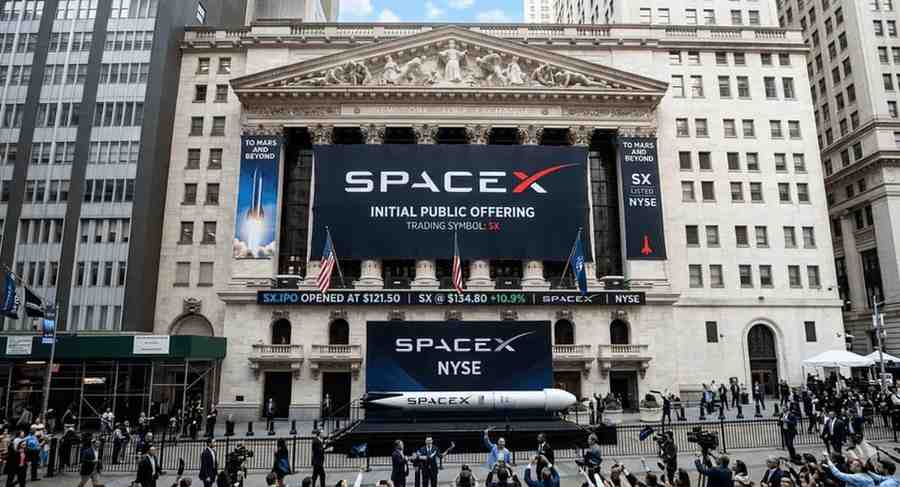
SpaceX IPO 2026: The Largest Listing in Market History
Ticker SPCX. $1.75 trillion valuation. A $75 billion raise that dwarfs Saudi Aramco. Here is everything you need to know before SpaceX begins trading on Nasdaq on June 12.
What is the SpaceX IPO?
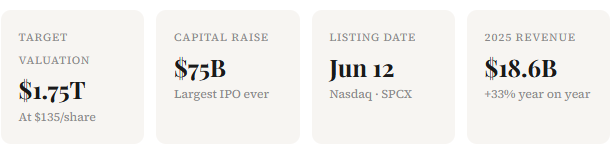
Space Exploration Technologies Corp. — better known as SpaceX — is set to become a publicly traded company on June 12, 2026, listing on the Nasdaq exchange under the ticker symbol SPCX. The offering targets a raise of approximately $75 billion at a valuation of $1.75 trillion, which would comfortably eclipse Saudi Aramco’s $29 billion raise in 2019 as the single largest initial public offering in recorded history.
Founded by Elon Musk in 2002, SpaceX has spent more than two decades as a privately held company, repeatedly deferring questions about a public listing. That changes this week. The S-1 prospectus was publicly filed with the SEC on May 20, 2026, and the investor roadshow launched on June 4. Share pricing is expected after market close on June 11, with the first day of trading on June 12. Reuters reports the indicative price is $135 per share, with 555.6 million Class A shares on offer.
"The SpaceX that is going public in June 2026 is not simply a rocket company — it is a vertically integrated space, connectivity, and artificial intelligence conglomerate."
How did we get here? A timeline
- December 2024 – SpaceX completes a $1.25 billion secondary share sale at $185/share, valuing it at $350 billion.
- July 2025 – Another insider share sale at $212/share lifts the valuation to $400 billion.
- December 2025 – Shares priced at $421 in a new insider sale, valuing SpaceX at ~$800 billion. IPO plans for 2026 begin to firm up. A $2.56 billion stock repurchase program is launched.
- February 2026 – SpaceX merges with Elon Musk’s AI company xAI at a combined valuation of $1.25 trillion, adding an AI segment to SpaceX’s financials.
- May 4, 2026 – SpaceX executes a 5-for-1 stock split ahead of the IPO.
- May 20, 2026 – The S-1 prospectus is publicly filed with the SEC.
- June 4, 2026 – Investor roadshow launches, a week ahead of earlier estimates.
- June 11, 2026 – Share pricing expected after market close.
- June 12, 2026 – SPCX begins trading on Nasdaq. History is made.
Three businesses inside one ticker
The SpaceX that investors will buy on June 12 is not the rocket company of popular imagination. The S-1 reveals three distinct revenue segments, each with a different growth profile and risk envelope.
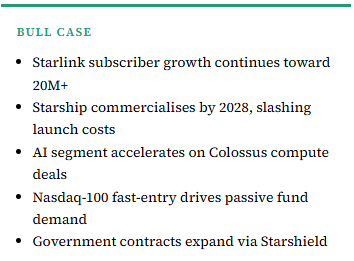
Connectivity (Starlink). This is the engine of current profitability. Starlink’s subscriber base grew from 1 million in December 2022 to over 10 million active customers as of Q1 2026. The connectivity segment posted a $1.19 billion operating profit in the most recent quarter. Government contracts — including the military-grade Starshield service — contributed around $3 billion in Starlink revenue in 2025.
Space (Launch & Starship). Falcon 9 remains the world’s most reliable orbital launch vehicle. Starship — still in development — is the most powerful rocket ever built. SpaceX spent nearly $3 billion on Starship R&D in 2025 alone.
AI (xAI / Grok / Colossus). The February 2026 merger with xAI added a third segment. The AI segment generated $3.2 billion in revenue in 2025. In May 2026, Anthropic agreed to pay $1.25 billion per month to access compute capacity from SpaceX’s Colossus supercomputers — a three-year deal.
Financials: growth with a costly undertow
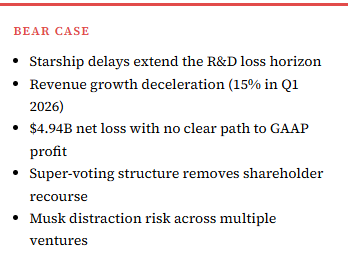
SpaceX’s top-line growth is impressive: 2025 revenue reached $18.67 billion, up 33% year on year. However, the company reported a net loss of approximately $4.94 billion in 2025. In Q1 2026, revenue growth slowed to 15% while the operating loss widened to $1.9 billion. At the targeted $135 IPO price, the offering implies a valuation of roughly 109–116 times trailing revenue.
Who controls SpaceX after the IPO?
Elon Musk retains 85.1% of the voting power through a super-voting share structure, meaning SPCX public shareholders will have minimal governance influence. Musk holds approximately 42% of the equity — a stake worth over $735 billion at the targeted valuation.
The retail allocation
Elon Musk has reportedly discussed allocating up to 30% of IPO shares directly to retail investors — at least three times the 5–10% typically reserved in standard large-cap offerings. That allocation is being routed through Robinhood, Fidelity, and Charles Schwab. Once SPCX trades on Nasdaq, any standard brokerage account will be able to buy shares.
How should investors approach the IPO?
History offers a cautionary note: first-day pops on high-profile tech IPOs frequently retrace 20–40% within the first 90 days. A conservative approach is to wait for SpaceX’s first earnings print as a public company, expected in early November 2026. If you do participate on day one, position-size accordingly — treat SPCX as a high-conviction growth satellite position, not a core holding.
Frequently asked questions
Trading is expected to begin on June 12, 2026, on the Nasdaq exchange under ticker SPCX. Share pricing is scheduled for June 11 after market close.
Reuters reports SpaceX is targeting $135 per share for 555.6 million Class A shares, aiming to raise $75 billion at a $1.75 trillion valuation.
Yes. SpaceX is reportedly allocating up to 30% of IPO shares to retail investors through Robinhood, Fidelity, and Charles Schwab — an unusually large retail tranche for an offering of this size.
Not yet on a GAAP basis. The connectivity (Starlink) segment is profitable, but heavy investment in Starship R&D and AI infrastructure resulted in a $4.94 billion net loss in 2025.
Yes. Musk retains 85.1% of voting control through a super-voting share class. Public shareholders in SPCX will have very limited ability to influence governance decisions.
Earlier reports discussed spinning off Starlink as a separate public company. Current reporting points to a wider SpaceX listing that includes Starlink as its connectivity segment.
Comparison – the SpaceX IPO valuation to other major tech IPOs
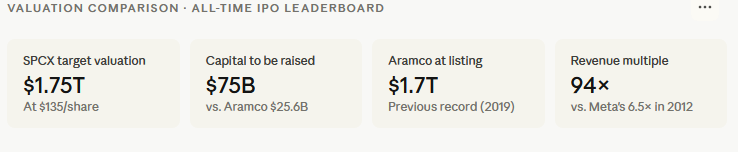
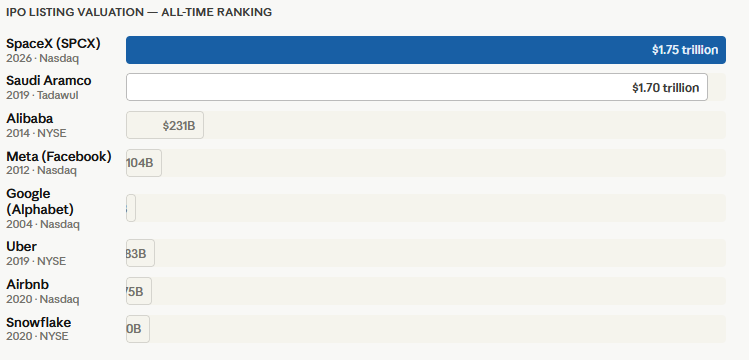
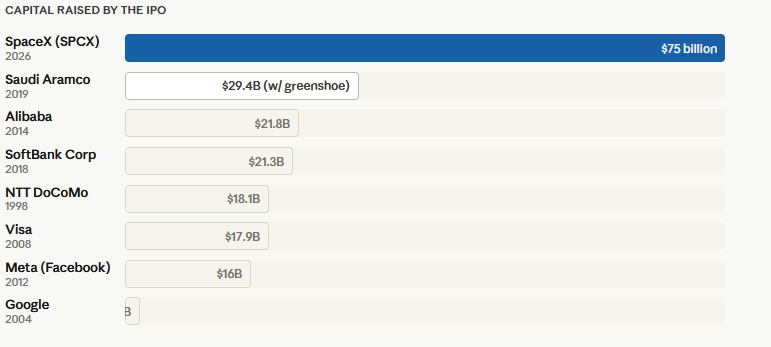
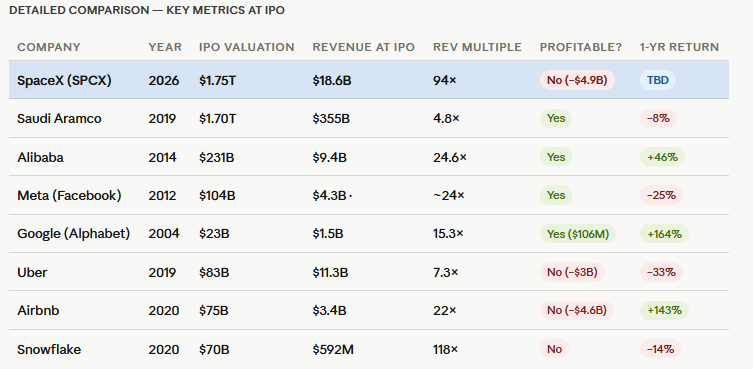
Here’s the full picture. A few standout findings from the data:
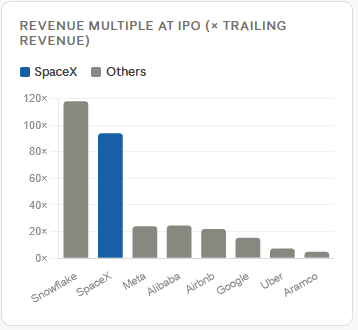
SpaceX vs. Saudi Aramco — two very different $1.7 trillion companies. Saudi Aramco’s IPO in 2019 raised $25.6 billion, making it the largest IPO of all time at the time, with a market value of $1.7 trillion. But Aramco listed at just 4.8× revenue — it was generating $355B a year and was deeply profitable. SpaceX is targeting the same valuation on just $18.6B in revenue. The premium is entirely a bet on future growth. Yahoo Finance
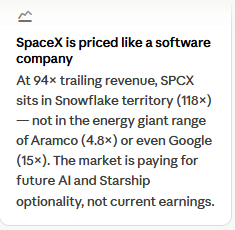
The revenue multiple is the most striking number. At 94× trailing revenue, SpaceX’s valuation is comparable to Snowflake, which debuted in 2020 at roughly $70 billion — and Snowflake was priced at ~118× revenue. Both are being valued on AI-era growth narratives rather than current earnings power. Capital.com
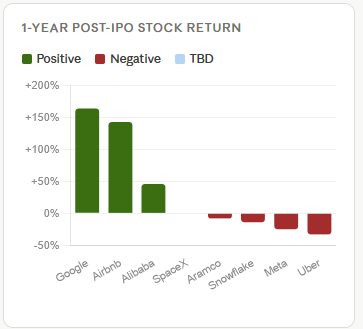
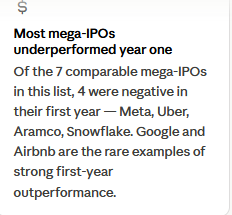
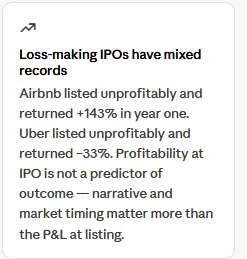
Loss-making IPOs have a wildly mixed track record. Saudi Aramco, SoftBank, Meta, and General Motors produced no clear directional signal for their home indices — the broad market drifted modestly higher or sideways. Uber lost 33% in its first year; Airbnb gained 143%. The P&L at listing turns out to be a poor predictor. Yahoo Finance
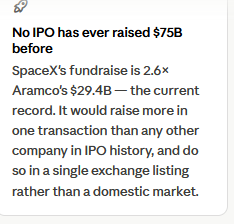
The capital raise is in a league of its own. SpaceX’s mega IPO is set to rewrite the record books, pursuing a $75 billion raise that would eclipse the world’s largest to date — Saudi Aramco’s listing in 2019. That’s 2.6× the previous record in a single transaction. CNBC
The most comparable historical analogue is probably Google. Google IPO shares priced at $85 per share for a valuation of $23 billion, and the stock surged nearly 18% on its first day of trading — going on to return +164% in year one. Google was also a growth company with a dominant but hard-to-value platform. The difference: Google was profitable at listing. SpaceX is not — yet.
This article is for informational purposes only and does not constitute financial advice. All valuations and financials are based on publicly reported figures as of June 8, 2026.