
Investor Guide
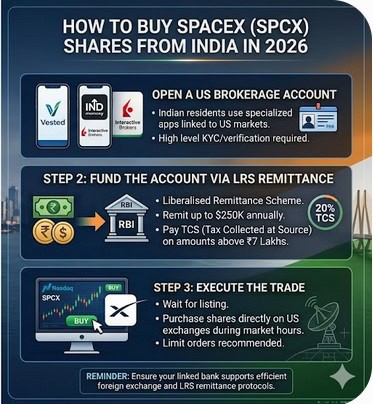
How to Buy SpaceX (SPCX) Shares from India in 2026
SpaceX lists on Nasdaq on June 12. Indian retail investors can legally buy SPCX shares — but the process, tax rules, and timing require careful planning. Here is your complete step-by-step guide.

Yes, it is legal. Indian resident investors can buy SPCX shares on the Nasdaq once they list, under the RBI’s Liberalised Remittance Scheme (LRS). You do not need special permission — just the right brokerage account and some advance preparation.
Three routes available to Indian investors
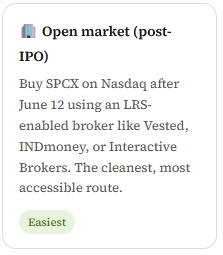
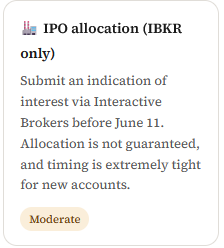
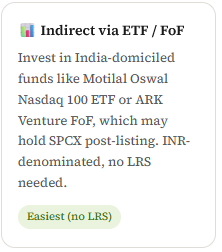
Step-by-step: buying SPCX directly from India
1. Choose a broker that supports US stocks under LRS
You need a platform that connects Indian residents to US exchanges via the RBI’s Liberalised Remittance Scheme. See the broker comparison below.
2. Complete your KYC online
Most platforms use DigiLocker and Aadhaar for paperless KYC. You’ll also need a PAN card. This typically takes 1–3 business days for verification.
3. Fund your account via LRS bank transfer
Transfer USD to your overseas brokerage account from your Indian savings account using LRS. Processing takes 7–14 days for new accounts. If you already have an account, ensure it has a USD balance before June 12.
4. (Optional) Submit IPO indication of interest
If using Interactive Brokers, you can submit an indication of interest in the SPCX IPO allocation before June 11. Allocations are not guaranteed. The 30% retail carve-out via Robinhood/Fidelity/Schwab is primarily for US residents.
5. Buy SPCX on the open market from June 12
Search for “SPCX” on your broker platform and place a limit order (not a market order — first-day IPO prices can be highly volatile). Consider waiting for the first few days of trading before buying, as post-IPO prices often fluctuate sharply.
6. Report your foreign holdings and file taxes
You must report foreign assets in your Indian ITR (Schedule FA). Capital gains and dividends are taxable in India. Claim foreign tax credit via Form 67 to avoid double
⚠ Timing warning: If you do not already have a funded overseas brokerage account, the LRS wire transfer and account verification process takes a minimum of 7–14 days. Given SpaceX is listing on June 12, the window to participate at the IPO price has already closed for new accounts. Open an account now to buy on the secondary market.
Tax rules every Indian investor must know
| Tax / rule | What it means for you | Rate / limit |
|---|---|---|
| LRS annual limit | Maximum you can remit abroad per financial year (April–March) under RBI rules. Includes all foreign spending — travel, education, investments. | $250,000 / year |
| TCS on remittance | Your bank deducts 20% TCS on LRS transfers above ₹10 lakh. This is a prepaid tax credit — you get it back when filing your ITR, or it adjusts your tax liability. Not an extra fee. | 20% above ₹10L |
| US withholding tax (dividends) | The US withholds 25% on dividends to Indian investors under India-US DTAA. SpaceX pays no dividends currently, so this is not immediately relevant. | 25% (DTAA rate) |
| Capital gains tax (India) | Gains from selling SPCX are taxed in India. Short-term (<24 months): income slab rate. Long-term (24+ months): 12.5% without indexation. | Slab / 12.5% LTCG |
| Foreign tax credit (Form 67) | If any tax is withheld in the US, claim credit in India to avoid double taxation. File Form 67 with your ITR before the due date. | File Form 67 |
| ITR foreign asset disclosure | Report all foreign holdings in Schedule FA of your Indian Income Tax Return every year. Non-disclosure can attract penalties under FEMA. | Mandatory annually |
TCS is not a tax loss — it is a prepayment. The 20% TCS deducted by your bank on LRS transfers above ₹10 lakh is credited against your income tax liability for the year. If your total tax payable is less than the TCS collected, you get a refund. Track it in your Form 26AS.
The indirect route: no LRS, no forex, no hassle
If setting up an overseas brokerage account feels complex, several India-domiciled mutual funds and ETFs invest in US technology stocks and may include SPCX after listing. These are available in INR through platforms like Zerodha, Groww, or Paytm Money — no LRS remittance required.
Options to watch: the Motilal Oswal Nasdaq 100 ETF/FoF tracks the Nasdaq 100 index (SPCX will be eligible for Nasdaq-100 inclusion 15 trading days after listing), the Mirae Asset NYSE FANG+ ETF for top US tech exposure, and the ARK Venture Fund (ARKVX) which held SpaceX pre-IPO via a special-purpose vehicle.
Should Indian investors buy SPCX at IPO or wait?
High-profile tech IPOs frequently see a first-day pop of 20–40%, followed by a correction as lock-up periods expire and early investors book profits. The practical playbook for most retail investors is to watch the first few days of trading, let the volatility settle, and buy on any meaningful post-IPO dip.
At $135 per share (approximately ₹11,300 at current exchange rates), even a single share of SPCX is accessible. Fractional shares on platforms like Vested and INDmoney mean you can start with as little as $10–$20 if you want initial exposure without committing a large amount.
Frequently asked questions
Yes. Under RBI’s Liberalised Remittance Scheme, any Indian resident can remit up to $250,000 per financial year to invest in foreign stocks, including US-listed companies like SPCX.
Interactive Brokers is best if you want IPO allocation access. Vested Finance and INDmoney are best for ease of use and fractional shares. Groww and ICICI Direct work well if you prefer an established Indian brand.
If buying whole shares, you need approximately $135 (≈ ₹11,300) per share plus forex and brokerage fees. With fractional shares on Vested or INDmoney, you can start with as little as $10.
Your bank automatically deducts 20% TCS on LRS remittances exceeding ₹10 lakh in a financial year. This amount is credited against your income tax liability and appears in Form 26AS. You can adjust or claim it back when filing your ITR — it is not an extra cost, just a prepayment.
NRIs are not covered under LRS, which is only for resident Indians. NRIs can typically invest through a US brokerage account, or through NRE/NRO-linked brokers like Angel One or ICICI Direct that accept NRI investors.
Yes. Any foreign financial assets must be reported in Schedule FA of your Indian Income Tax Return every year. Failure to disclose foreign assets can attract penalties under FEMA and the Black Money Act.
The 30% retail allocation is routed through Robinhood, Fidelity, and Schwab — primarily for US residents. Indian investors without existing funded IBKR accounts are very unlikely to access the $135 IPO price and should plan to buy on the secondary market from June 12.
___________________________________________________________
Here’s the full India-specific guide on buying SPCX. The most important practical takeaways for Indian investors right now:
On timing: If you do not already have an overseas brokerage account, the LRS wire transfer and account verification process takes 7 to 14 days at minimum. Given the expected listing in mid June 2026, this window is extremely tight. The IPO allocation through Robinhood/Fidelity/Schwab is only available to US residents — so Indian investors will need to buy on the secondary market from June 12. Equityresearchindia
On legality: Thanks to the RBI’s Liberalised Remittance Scheme (LRS), Indian residents are allowed to send up to $250,000 per year abroad to invest in foreign stocks, including US IPOs. Apps like Vested, Groww, and INDmoney use this rule to give you access to the US markets. Stock Market Mentor
On TCS: For Indian residents investing in global stocks and ETFs, the TCS rate is 20%, applicable only on amounts exceeding ₹10 lakh in a financial year. This means for the first ₹10 lakh you remit abroad in a year, there is zero TCS. Crucially, TCS is not an extra fee — it’s a prepaid tax credit you recover when filing your ITR. Paasa, Inc.
On the indirect route: Motilal Oswal Nasdaq 100 ETF/FoF tracks the Nasdaq 100 index. All investments are in INR — no USD conversion required, and no LRS limit needed. Since SPCX will be eligible for Nasdaq-100 inclusion 15 trading days after listing, this is a passive backdoor into SpaceX exposure without any overseas account setup.
This article is for informational purposes only and does not constitute financial, investment, legal, or tax advice. US stock investing involves currency risk, market risk, and regulatory compliance obligations specific to your residency and tax status. Consult a SEBI-registered financial advisor and a qualified tax professional before making investment decisions. All figures are based on publicly available information as of June 8, 2026 and are subject to change.