

IPO Analysis OpenAI IPO 2026 — Full Guide Breaking · June 2026
The OpenAI IPO: Everything Investors Need to Know in 2026
OpenAI IPO 2026: Valuation, Filing Date, Revenue & How to Invest
OpenAI confidentially filed for a public listing on June 8, 2026, targeting a September debut that could become the largest IPO in stock-market history. Here is the definitive guide to what it means for investors.
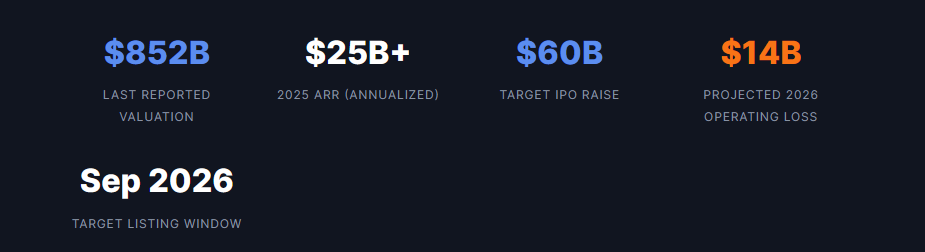
Table of Contents
- What Is the OpenAI IPO?
- From Nonprofit to Public Benefit Corporation
- The SEC Filing: What We Know
- Valuation: The Path to $1 Trillion
- Revenue Growth vs. Brutal Cash Burn
- Corporate Structure & Key Shareholders
- Expected IPO Timeline
- Key Risks Every Investor Must Understand
- How to Invest in the OpenAI IPO
- OpenAI vs. SpaceX: The Battle for the Largest IPO in History
- Frequently Asked Questions
Overview
What Is the OpenAI IPO?
OpenAI — the San Francisco–based artificial intelligence company behind ChatGPT and the GPT series of large language models — has taken the formal first step toward becoming a publicly traded company. On June 8, 2026, OpenAI confirmed it had confidentially submitted a draft S-1 registration statement with the U.S. Securities and Exchange Commission (SEC), setting the stage for what analysts describe as potentially the most consequential stock-market debut in a generation.
The move places OpenAI in direct competition with SpaceX, which filed its own IPO prospectus in the same week and is targeting a raise of up to $75 billion. Both listings are racing for the title of the largest IPO in history, a record currently held by Saudi Aramco’s 2019 listing at $25.6 billion.
Key Point
A confidential S-1 filing is the formal first step toward going public. It does not set a listing date or a final price. Under SEC rules, OpenAI can withdraw or amend the filing before launching a public roadshow.
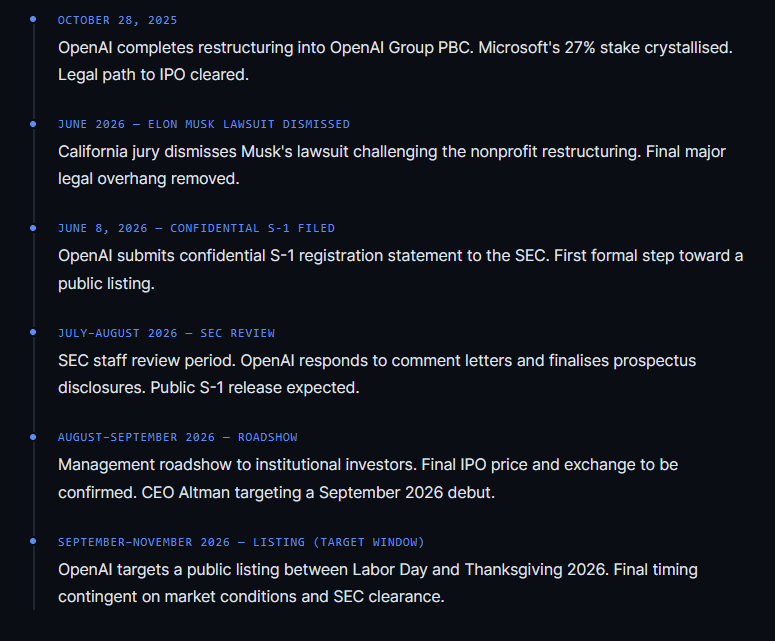
OpenAI explicitly stated at the time of filing that it has “not decided on timing yet” and that a listing “may be a while.” However, multiple sources with direct knowledge of the process indicate that CEO Sam Altman is personally targeting a September 2026 debut.
Corporate History
From Nonprofit to Public Benefit Corporation
Understanding the OpenAI IPO requires understanding the unusual institutional path that led to it. OpenAI was founded in December 2015 as a nonprofit research laboratory, with the explicit mission of developing artificial general intelligence (AGI) safely and for the benefit of humanity. Backers at the time, including Elon Musk and Sam Altman, contributed approximately $1 billion in early pledges.
In 2019, OpenAI created a capped-profit subsidiary to attract the kind of capital its research ambitions required. Under that structure, investor returns were limited, complicating any path to a public listing. Microsoft’s now-famous multi-billion-dollar investment came through this entity.
The October 2025 Restructuring
The pivotal change came on October 28, 2025, when OpenAI completed a full corporate recapitalization. The for-profit arm was converted into a Public Benefit Corporation (PBC), legally named OpenAI Group PBC. The original nonprofit was renamed the OpenAI Foundation and retained a controlling equity stake currently valued at approximately $130 billion.
Structural Note
OpenAI Group PBC is legally required to advance its stated mission and consider the broader interests of all stakeholders — not just shareholder returns. This PBC structure is unprecedented for a company of this scale and magnitude considering a public listing.
This restructuring removed the 100x investor return cap that had made a traditional IPO structurally impossible and satisfied regulators in both California and Delaware, who reviewed the conversion and ultimately did not oppose it.
A major legal overhang was also cleared in June 2026, when a California jury dismissed a lawsuit filed by co-founder Elon Musk challenging the restructuring as a betrayal of the original nonprofit mission — removing one of the last institutional obstacles to the IPO.
The SEC Filing
The S-1 Filing: What We Know
A confidential S-1 filing allows a company to share its detailed financial disclosures with the SEC before making them public, typically giving it time to work through regulatory questions quietly before the full roadshow. OpenAI filed confidentially on June 8, 2026.
Once the SEC review process is complete — typically six to eight weeks — OpenAI will be required to publicly release an amended S-1 prospectus containing audited financial statements, detailed risk factors, executive compensation disclosures, cap-table details, and use-of-proceeds statements. That public filing is expected in late July or August 2026 and will be the first time many of OpenAI’s financial figures are subject to independent audit and full disclosure.
Investor Warning
All financial figures currently cited — including revenue, valuation, and loss projections — derive from private funding rounds, leaked internal documents, and media reports. None have been independently audited as of this writing. The official prospectus will be the first binding public disclosure.
Lead Underwriters
OpenAI has held informal discussions with several major Wall Street investment banks. While no lead underwriter has been officially named, Goldman Sachs, JPMorgan Chase, and Morgan Stanley are widely expected to compete for the mandate on what would be a landmark transaction for any bank. OpenAI also hired Ajmere Dale as Chief Accounting Officer and Cynthia Gaylor as Corporate Business Finance Officer to oversee IPO readiness, investor relations, and the SEC filing process.
Valuation Analysis
Valuation: The Path to $1 Trillion
OpenAI’s reported valuation has roughly doubled every twelve months. The progression is striking:
| Date | Reported Valuation | Event |
|---|---|---|
| Late 2023 | $86B | Secondary share sale |
| Mid-2024 | $157B | Primary fundraising round |
| Early 2025 | $300B+ | SoftBank-led financing |
| Oct 2025 | $500B | Employee share sale / restructuring |
| Mar 2026 | $852B | Most recent private funding round |
| IPO target | $1T+ | Bullish analyst projection |
Pre-IPO reporting currently places OpenAI’s valuation in the $730 billion to $852 billion range. Some bullish analysts argue a $1 trillion valuation is achievable if the company can demonstrate a credible path to its stated target of $100 billion in annual revenue by 2027.
What the Multiples Look Like
Context matters. At an $830 billion valuation, OpenAI’s price-to-sales ratio based on its 2025 revenue would be approximately 65 times — far above the multiples commanded even by the most highly valued technology companies at their IPOs. For comparison, Meta was valued at $104 billion when it went public in 2012; Uber fetched $82 billion in 2019.
The bull case rests on a single argument: that OpenAI is not being valued on current revenue but on total addressable market and trajectory. If annualised revenue hits $100 billion by 2027, a $1 trillion valuation represents only 10x forward revenue — a multiple that premium SaaS businesses regularly sustain.
Skeptic’s View
HSBC analysts estimate OpenAI will need to raise an additional $207 billion through 2030 just to remain viable on its current investment trajectory. With roughly $600 billion in compute commitments over the next five years and $25 billion in current annualised revenue, the IPO is, in the words of analysts, “a funding necessity, not a victory lap.”
Financials
Revenue Growth vs. Brutal Cash Burn
OpenAI’s revenue growth over the past three years is genuinely extraordinary. The company went from roughly $2 billion in annualised revenue at the end of 2023 to $6 billion in 2024 to more than $20 billion by end-2025, confirmed by CFO Sarah Friar. Annualised revenue reached $25 billion by February 2026, with Altman targeting $100 billion by 2027.
Revenue Drivers
OpenAI’s revenue comes from three primary sources: paid ChatGPT subscriptions (led by the $20/month ChatGPT Plus tier), enterprise API access, and a rapidly growing direct business segment called OpenAI Frontier targeting companies embedding AI into existing platforms such as Salesforce and Workday. The company has also announced plans to introduce an ad-supported tier priced between $5 and $8 per month, with a $100 billion advertising revenue target by 2030.
The Cash Burn Problem
The other side of the ledger is considerably less comfortable. For full-year 2025, OpenAI generated $13.1 billion in revenue but burned through approximately $22 billion to do it — a net loss of roughly $9 billion. Internal projections, reported by The Information, suggest an operating loss of $14 billion in 2026. Cumulative losses are projected to reach $44 billion before profitability arrives, currently targeted for around 2029–2030.
| Year | Revenue | Operating Loss | Status |
|---|---|---|---|
| 2023 | ~$2B | ~$(5B) | Loss |
| 2024 | $6B | ~$(7B) | Loss |
| 2025 | $13.1B | ~$(9B) | Loss |
| 2026E | $25B+ | ~$(14B) | Loss (proj.) |
| 2029–30E | TBD | — | Breakeven (target) |
A large share of the spending goes toward compute. OpenAI’s Project Stargate — a joint venture with SoftBank, Oracle, and others to build AI data centre infrastructure — had reached nearly 7 gigawatts of planned capacity and more than $400 billion in committed investment over three years by September 2025. Some infrastructure deals reportedly stretch to $1.4 trillion over eight years, creating significant long-term capital obligations that will be central disclosures in the public prospectus.
Cap Table & Governance
Corporate Structure and Key Shareholders
| Shareholder / Entity | Approx. Stake | Notes |
|---|---|---|
| OpenAI Foundation (nonprofit) | ~25.8% | Controls board; proceeds fund philanthropy |
| Microsoft | ~27% | $13B invested; Azure access through 2032 |
| SoftBank | Significant | Led $300B+ round; co-funds Stargate |
| Thrive Capital | Significant | Long-term VC backer |
| Abu Dhabi MGX | Significant | Sovereign wealth fund |
| Sam Altman & management | Undisclosed | Altman’s equity share not publicly confirmed |
The Microsoft Relationship
Microsoft has invested approximately $13 billion in OpenAI since 2019. At OpenAI’s March 2026 valuation of $852 billion, that stake is worth an estimated $228 billion — a reported 17.6x return on capital. As part of the restructuring agreement, Microsoft retains model access — including access to any AGI milestone models — through 2032, and OpenAI’s non-compete obligations to Azure have been modified. Despite holding 27% equity, Microsoft holds no board seats; the OpenAI Foundation retains full board appointment authority.
The AGI Clause
A significant structural wildcard remains embedded in the Microsoft deal: if OpenAI achieves artificial general intelligence — to be verified by an independent expert panel — certain provisions of the Microsoft partnership are reportedly voided or renegotiated. This clause will be among the most closely scrutinised disclosures in the public S-1.
IPO Roadmap
Expected IPO Timeline
Risk Analysis
Key Risks Every Investor Must Understand
1. Deep and Structural Unprofitability
OpenAI has never turned a profit. With projected losses of $14 billion in 2026 and a cumulative deficit expected to reach $44 billion before breakeven, investors are being asked to underwrite a multi-year bet on a trajectory that does not yet exist in audited financial statements. Profitability is not targeted until 2029–2030.
2. Intensifying Competition
The competitive landscape has changed dramatically since ChatGPT launched in late 2022. Google’s Gemini has been closing the market-share gap on ChatGPT. Anthropic — which has also filed for a public listing — is gaining traction with enterprise and developer customers on a safety-differentiated platform. Meta’s Llama models are open-source and free. Regulatory filings will require OpenAI to articulate a defensible moat in this context.
3. Unprecedented Corporate Governance
OpenAI’s Public Benefit Corporation structure, with a nonprofit parent retaining board control, is untested at this scale in public markets. Any future conflict between the OpenAI Foundation’s mission and the maximisation of shareholder value becomes a public company event — subject to proxy fights, shareholder litigation, and activist pressure. Investors have no historical template to value this dynamic.
4. Massive Capital Requirements
HSBC analysts estimate OpenAI needs to raise a further $207 billion through 2030. With $600 billion in compute commitments over five years and revenue at $25 billion annualised, the gap between spending commitments and earnings is structural. The IPO is partly designed to help bridge it, but public equity markets alone cannot cover the full obligation.
5. Regulatory and Legal Exposure
OpenAI faces active regulatory scrutiny on AI safety, data privacy, and alleged psychological harms caused by its chatbot products. A public listing will require much fuller disclosure of those liabilities. Mandatory quarterly reporting to shareholders will also introduce pressure that could conflict with OpenAI’s stated mission-first culture.
6. Talent Retention Post-IPO
Pre-IPO equity has been the primary retention tool for OpenAI’s engineering and research talent. Once public, new hires receive stock options rather than pre-IPO equity — potentially making compensation packages less attractive at precisely the moment when rivals are scaling aggressively.
Contrarian View
NYU Stern professor and tech analyst Scott Galloway has publicly argued there is a “nonzero probability” that OpenAI could pull its IPO entirely, citing a closing competitive gap, high cash burn, and brand perception risk. While the confidential filing signals genuine intent, market conditions between now and November 2026 remain the wildcard.
Investor Guide
How to Invest in the OpenAI IPO
Before the IPO: No Direct Access
Retail investors cannot purchase OpenAI shares before the public listing. The pre-IPO equity market is restricted to accredited investors via private secondary platforms, and valuations on those platforms reflect the same $730–$852 billion range already cited in institutional rounds.
Indirect Exposure Now: Proxy Plays
For investors who want near-term exposure to OpenAI’s growth story, the most direct route is through Microsoft (MSFT), which holds a ~27% stake that analysts at multiple banks have called the single most underappreciated asset on Microsoft’s balance sheet. SoftBank Group (9984 on the Tokyo Stock Exchange) also offers partial exposure, as does Nvidia (NVDA), which supplies the overwhelming majority of the compute infrastructure powering OpenAI’s models.
At IPO: Standard Brokerage Access
Once OpenAI prices and lists, shares will be available through any standard brokerage account on the exchange of its choosing — most likely NASDAQ. IPO allocations at the offer price are typically reserved for institutional investors in the book-building process; retail buyers generally access shares once secondary trading opens. First-day price volatility on high-profile AI listings has been significant historically, so timing and position-sizing discipline will matter.
What to Watch Before Committing Capital
The public S-1 prospectus, expected in late July or August 2026, will be the most important document for any prospective investor. Key data points to interrogate: audited revenue and loss figures, detailed subscription and churn metrics, the exact terms of the Microsoft and SoftBank agreements, capital expenditure commitments, the full terms of the OpenAI Foundation’s governance rights, and management’s path to profitability with specific milestones.
Market Context
OpenAI vs. SpaceX: The Battle for the Largest IPO in History
OpenAI’s filing coincides almost precisely with SpaceX’s own IPO process, filed in the same week of June 2026. The two companies are in direct competition for what Deutsche Bank Research describes as a record-breaking listing. SpaceX is targeting a raise of up to $75 billion at a valuation of between $1.75 trillion and $2 trillion — higher than OpenAI’s current range but in a different industry with demonstrably positive cash flows.
| Metric | OpenAI | SpaceX |
|---|---|---|
| Target Valuation | $730B–$1T+ | $1.75T–$2T |
| Target Raise | ~$60B | Up to $75B |
| 2025 Revenue | $13.1B | Est. $10B+ |
| Profitability | 2029–30 (target) | Reportedly profitable |
| Industry | Generative AI / SaaS | Space launch / Starlink |
| S-1 Status | Confidential (Jun 2026) | Filed (Jun 2026) |
The two listings are expected to compete for the same pool of institutional capital in what will be an unprecedented IPO window. Market observers note that the sheer scale of both raises — combined well over $100 billion — may absorb significant liquidity from the broader equity market in Q3 2026.
FAQ
Frequently Asked Questions About the OpenAI IPO
OpenAI filed confidentially with the SEC on June 8, 2026. CEO Sam Altman is targeting a public debut in September 2026. The broader company-stated window runs from Labor Day to Thanksgiving 2026. No official date has been confirmed.
Pre-IPO reporting places the valuation between $730 billion and $852 billion, based on the most recent private funding rounds. Bullish sell-side analysts project a $1 trillion valuation is achievable if the company demonstrates continued revenue growth during the roadshow. The final price will only be set during the book-building process immediately before listing.
OpenAI is reportedly targeting a raise of approximately $60 billion. If completed at that level, it would more than double Saudi Aramco’s 2019 record listing of $25.6 billion. SpaceX, also filing in June 2026, is targeting up to $75 billion.
No. For full-year 2025, OpenAI generated $13.1 billion in revenue against approximately $22 billion in costs, for a net loss of around $9 billion. The company projects a $14 billion operating loss in 2026 and does not expect to reach profitability until approximately 2029–2030.
No exchange has been officially confirmed. NASDAQ is widely expected given that it is the exchange of choice for high-growth technology companies. The exchange decision will be disclosed in the public prospectus.
Retail investors cannot access pre-IPO shares directly. Once OpenAI lists on a public exchange, shares will be purchasable through any standard brokerage account. IPO allocations at the offer price are typically reserved for institutional investors; retail buyers access shares in secondary trading. For indirect pre-IPO exposure, Microsoft (MSFT) is the most direct proxy given its ~27% ownership stake.
OpenAI’s principal shareholders are Microsoft (~27%), the OpenAI Foundation nonprofit (~25.8%), SoftBank, Thrive Capital, and Abu Dhabi’s MGX sovereign wealth fund. Microsoft invested approximately $13 billion across multiple rounds; at the $852 billion valuation, that stake is worth an estimated $228 billion.
The OpenAI Foundation is the renamed original nonprofit that retains a controlling equity stake and full board appointment authority over OpenAI Group PBC. Its mission is to advance AI safely for the benefit of humanity. In theory, this mission mandate can override purely profit-maximising decisions. How this dynamic plays out in a public company setting is a governance risk with no historical precedent at this scale.
Can Indians Invest in the OpenAI IPO?
Short answer: Not directly at IPO allocation, but yes through secondary markets once it lists — via the LRS route.
The Core Constraint: US IPOs Don’t Allocate to Indian Retail Investors
Direct IPO allocation is nearly impossible for Indian retail investors. US IPOs allocate shares to American institutional and retail investors first. Indians must buy shares after the listing begins on the secondary market. So you won’t be able to apply for OpenAI shares at the offer price the way you would for an Indian IPO on NSE/BSE through ASBA. Winvesta
How Indians CAN Invest — Post-Listing
Once OpenAI is listed on NASDAQ (the expected exchange), Indian investors can buy shares through the Liberalised Remittance Scheme (LRS). Here’s how:
Step 1 — Open a US brokerage account linked to an Indian bank. Platforms popular in India include Vested Finance, INDmoney, Groww (US stocks), Stockal, and HDFC Securities’ international option.
Step 2 — Remit funds via LRS. The LRS limit stays unchanged for FY 2026-27. The current limit is $250,000 per financial year per individual — more than enough for most retail positions. Winvesta
Step 3 — Buy in secondary trading. Once OpenAI lists and trading opens, shares are available like any other US stock. You can buy fractional shares on most platforms, so a full share price in the hundreds of dollars isn’t a barrier.
The GIFT City Route
Once OpenAI is listed, Indian investors may be able to gain exposure through GIFT City channels with relatively simpler access, with no need to open a traditional US brokerage account. GIFT City (Gujarat International Finance Tec-City) is India’s international financial centre and is emerging as a cleaner domestic route for investing in foreign-listed stocks. The Sunday Guardian
Pre-IPO Options (Very Limited)
Pre-IPO investments are available only to accredited investors. Some platforms such as Vested Finance now offer pre-IPO access to private companies with a $10,000 minimum, but these are secondary-market transactions — not guaranteed IPO allocations. These are high-risk, illiquid bets and not suitable for most retail investors. ForgeWinvesta
Indirect Exposure Right Now (Before IPO)
If you want OpenAI exposure today without waiting for the listing:
- Microsoft (MSFT) — holds ~27% of OpenAI; available via LRS on any US brokerage
- SoftBank (9984.T) — Tokyo-listed; co-investor in OpenAI
- Nvidia (NVDA) — powers OpenAI’s compute infrastructure
Tax Points for Indian Investors
- US dividends are subject to 25% withholding tax at source, but the India-US Double Taxation Avoidance Agreement (DTAA) lets you claim a foreign tax credit — file Form 67 with your ITR.
- Capital gains on US stocks are taxed in India as per your applicable slab (short-term) or at 20% with indexation (long-term, held >24 months for listed foreign shares).
- You must declare foreign assets in Schedule FA of your ITR every year once you hold US stocks.
One Timing Note Worth Sharing
Research shows 4 out of 5 IPOs underperform a small-cap index over 3 to 5 years. Average first-day returns reach 18.8%, but the average 3-year annualised return for stocks bought at first-day close sits at just 6% — versus 11% for the broader market. Strategic entry points include waiting for lock-up expiration at 90 to 180 days post-IPO, when insider selling often creates price dips. Winvesta
Bottom line for Indian investors: You can participate — just not at the IPO price. The LRS route via platforms like Vested, INDmoney, or Groww US is your most practical path once trading begins, likely in September–November 2026.
Disclaimer
This article is for informational purposes only and does not constitute financial or investment advice. All valuations and financial projections cited are based on media reports and private market transactions and have not been independently audited. Investing in IPOs involves significant risk, including the risk of total loss of invested capital. Consult a qualified financial adviser before making investment decisions.
How to Buy SpaceX (SPCX) Shares from India in 2026