
What is CE and PE in Stock Market Trading? A Beginner’s Guide to Call and Put Options
What is CE and PE in Stock Market Trading?
If you have ever looked at the options chain of stocks or indices like the NIFTY 50 or SENSEX, you may have noticed terms such as CE and PE beside various strike prices.
CE and PE are the two basic types of options contracts traded in the derivatives market. Understanding them is essential for anyone interested in options trading.
- CE = Call Option
- PE = Put Option
These contracts allow traders to speculate on market movements or hedge their existing investments.
Understanding Options Trading
Options are financial contracts that give the buyer the right, but not the obligation, to buy or sell an asset at a predetermined price before a specific expiry date.
Options are widely used in:
- Stock trading
- Index trading
- Hedging investments
- Income generation strategies
- Risk management
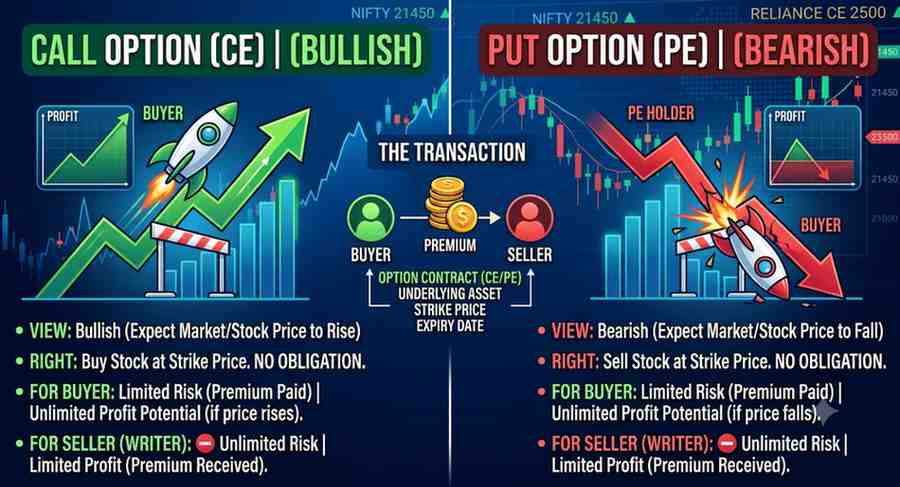
What is CE (Call Option)?
A Call Option (CE) gives the buyer the right to purchase an underlying asset at a specific strike price before expiry.
Traders generally buy CE when they expect the market or stock price to rise.
Example of a Call Option
Suppose:
- NIFTY is trading at 25,000
- You buy a 25,100 CE
- Premium paid = ₹100
If NIFTY rises to 25,400 before expiry:
- Your option gains value
- You can sell the option at a profit
If NIFTY falls below 25,100:
- The option may expire worthless
- Your maximum loss is limited to the premium paid
When to Buy CE?
You may consider buying a Call Option when:
- You expect bullish market movement
- Positive economic news is expected
- A stock is showing strong upward momentum
What is PE (Put Option)?
A Put Option (PE) gives the buyer the right to sell an underlying asset at a predetermined strike price before expiry.
Traders buy PE when they expect the market or stock price to decline.
Example of a Put Option
Suppose:
- NIFTY is trading at 25,000
- You buy a 24,900 PE
- Premium paid = ₹120
If NIFTY falls to 24,500:
- The value of your Put Option increases
- You can sell it at a profit
If NIFTY rises:
- The option may lose value
- Maximum loss is limited to the premium paid
When to Buy PE?
You may consider buying a Put Option when:
- You expect the market to fall
- Negative news may impact stock prices
- You want protection for your investment portfolio
Difference Between CE and PE
| Feature | CE (Call Option) | PE (Put Option) |
|---|---|---|
| Full Form | Call Option | Put Option |
| Market View | Bullish | Bearish |
| Profit When | Price rises | Price falls |
| Risk for Buyer | Premium paid | Premium paid |
| Usage | Speculate on upward movement | Speculate on downward movement |
Understanding Strike Price
A strike price is the predetermined price at which the option can be exercised.
For example:
- 25,000 CE = Right to buy at 25,000
- 25,000 PE = Right to sell at 25,000
The relationship between market price and strike price determines the option’s value.
What Does ITM, ATM, and OTM Mean?
1. In-The-Money (ITM)
For CE:
- Strike price below current market price
For PE:
- Strike price above current market price
2. At-The-Money (ATM)
- Strike price equals current market price
3. Out-Of-The-Money (OTM)
For CE:
- Strike price above market price
For PE:
- Strike price below market price
Understanding these concepts helps traders choose appropriate strike prices.
Why Do Traders Use CE and PE?
1. Leverage
Options allow traders to control larger positions with relatively small capital.
2. Limited Risk
For option buyers, maximum loss is generally limited to the premium paid.
3. Hedging
Investors can use PE contracts to protect their portfolios during market downturns.
4. Income Generation
Experienced traders may use option selling strategies to earn premium income.
Advantages of CE and PE Trading
Benefits
✔ Lower capital requirement
✔ Potentially high returns
✔ Hedging opportunities
✔ Flexible trading strategies
✔ Suitable for bullish and bearish markets
Risks of CE and PE Trading
Options trading also carries risks:
Time Decay
Option value decreases as expiry approaches.
Volatility Risk
Changes in market volatility affect option premiums.
Total Premium Loss
If the market moves against your prediction, the option may expire worthless.
Complexity
Options require understanding of Greeks, volatility, and risk management.
Role of Stop Loss in Stock market trading
Simple Rule to Remember
A quick way to remember:
- Buy CE when you expect prices to go UP
- Buy PE when you expect prices to go DOWN
This simple rule forms the foundation of most beginner options trading strategies.
Frequently Asked Questions (FAQs)
Is CE bullish or bearish?
CE (Call Option) is generally considered a bullish position because traders buy it when they expect prices to rise.
Is PE bullish or bearish?
PE (Put Option) is generally considered a bearish position because traders buy it when they expect prices to fall.
Can I lose more than my premium in CE or PE buying?
No. For option buyers, the maximum loss is typically limited to the premium paid.
Which is better: CE or PE?
Neither is inherently better. CE is used when expecting a rise in prices, while PE is used when expecting a fall.
Can beginners trade CE and PE?
Yes, but beginners should first understand option pricing, risk management, and market behavior before trading with real money.
*Investments in the securities market are subject to market risks. Read all the related documents carefully before investing.
Conclusion
CE (Call Option) and PE (Put Option) are the building blocks of options trading. A Call Option is typically used when traders expect prices to rise, while a Put Option is used when they expect prices to fall. Understanding how these contracts work can help traders manage risk, hedge investments, and explore opportunities in both rising and falling markets.
For beginners, learning the fundamentals of CE and PE before placing trades can significantly improve decision-making and risk management in the stock market.
NOTE: *** The above information is based on the source and just for information and educational purposes only. Please consult your financial advisor before buying any stocks. Thank You ***