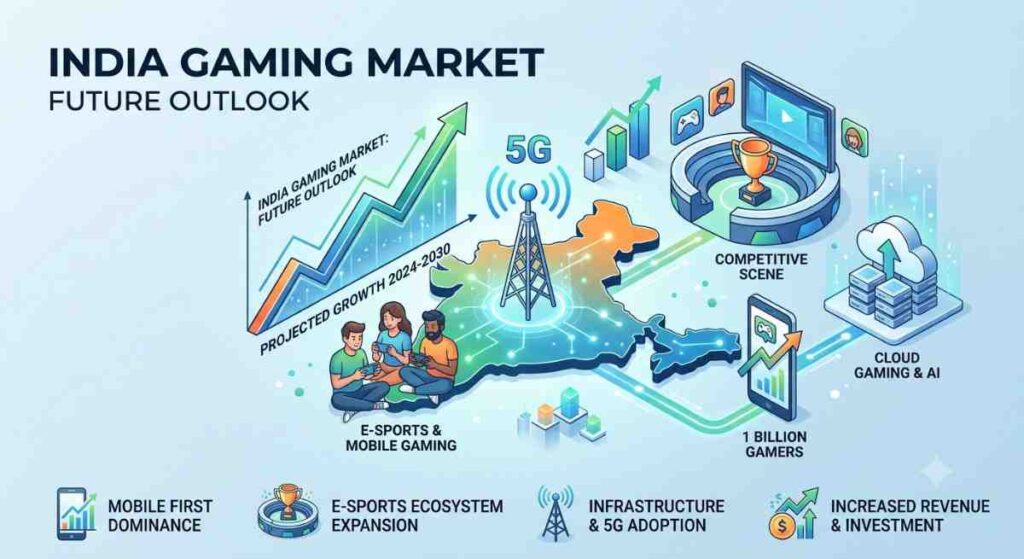
India Gaming Market: Future Outlook
How mobile gaming, esports, and evolving regulation are shaping the next phase of growth for one of the world’s largest gaming populations.
India has quietly become one of the largest gaming markets in the world by user base, driven by cheap mobile data, a young population, and rapid smartphone adoption. While monetization has historically lagged behind user growth, the country’s gaming ecosystem is entering a phase where infrastructure, regulation, and investor interest are starting to align. This article looks at where the market stands and where it’s headed.
Current State of the Market
Mobile gaming dominates the Indian landscape, accounting for the vast majority of both players and revenue. Casual and hyper-casual titles remain the entry point for most users, while real-money gaming (RMG) formats — fantasy sports, rummy, and poker — have historically generated a disproportionate share of revenue relative to their user base. Console and PC gaming remain niche by comparison, constrained by hardware costs and import duties, though they retain a loyal and growing enthusiast community.
Key context: India’s gaming growth story has been led by scale rather than spend — the country has more gamers than almost anywhere else, but average revenue per user remains well below markets like the US, China, or South Korea, leaving significant monetization headroom.
Key Growth Drivers
- Smartphone and data penetration: Continued affordability of smartphones and mobile data keeps unlocking new users, particularly in Tier 2 and Tier 3 cities.
- Regional language content: Games and platforms localizing for Hindi and regional languages are seeing stronger engagement outside metro markets.
- UPI and digital payments: Frictionless payment rails make in-game purchases and RMG deposits far easier than in previous years.
- Esports and streaming culture: Rising viewership on platforms hosting competitive gaming content is building a spectator economy alongside the player economy.
- Domestic game development: A growing base of Indian studios is building original IP rather than only distributing global titles.
Segment-Wise Outlook
Mobile & Casual Gaming
This segment will likely remain the largest by user count, with growth increasingly coming from deeper engagement and in-app monetization rather than pure user acquisition, as the low-hanging fruit of first-time smartphone users diminishes.
Real-Money Gaming (RMG)
RMG has been the most lucrative but also the most regulation-sensitive segment. Its future trajectory depends heavily on how state and central rules evolve, including taxation treatment and licensing requirements, which have already reshaped operator economics in recent years.
Esports
Esports is transitioning from a niche enthusiast activity to a more organized industry with sponsorships, franchise leagues, and college-level competitive circuits. Monetization is still developing, but audience growth has been consistent.
Console & PC Gaming
This remains a smaller but premium segment. Growth here is tied to disposable income trends and platform localization rather than mass-market dynamics.
| Segment | Growth Outlook | Primary Constraint |
|---|---|---|
| Mobile / Casual | Steady, high-volume growth | Monetization depth |
| Real-Money Gaming | High but regulation-dependent | Policy and taxation clarity |
| Esports | Strong audience growth | Sponsorship monetization |
| Console / PC | Moderate, premium growth | Hardware affordability |
Regulatory Landscape
Regulation is arguably the single biggest variable shaping the market’s future. Central and state-level rules around real-money gaming, taxation on gaming revenue, and classification of games of skill versus chance have shifted meaningfully in recent years, and further change is likely. Companies operating in this space are increasingly building compliance and government-affairs capability alongside product teams, treating regulatory navigation as a core competency rather than a side function.
Because rules can differ by state and continue to evolve, operators and investors generally treat regulatory tracking as an ongoing requirement rather than a one-time assessment.
Investment & Industry Trends
- Consolidation among mid-sized studios and platforms as smaller players struggle with rising user-acquisition costs and compliance overhead.
- Increased interest from global publishers looking to co-develop or localize titles specifically for the Indian market.
- Growth of ancillary industries — streaming, game-adjacent content creation, and gaming peripherals — as the broader ecosystem matures.
- Greater institutional investment moving toward companies with clear compliance postures, reflecting the regulatory sensitivity of the sector.
Challenges to Watch
- Regulatory uncertainty: Ongoing shifts in taxation and licensing create planning difficulty for operators.
- Monetization gap: Converting a massive free-to-play user base into paying users remains difficult outside RMG.
- Infrastructure limits: Latency and connectivity issues in rural areas still limit real-time multiplayer and esports participation.
- Player protection concerns: Rising scrutiny around responsible gaming, particularly in real-money formats, is prompting stricter safeguards.
Future Outlook Summary
Over the coming years, India’s gaming market is likely to grow less on the back of pure user-count expansion and more through deeper monetization, regional-language content, and a maturing esports and content ecosystem. Regulatory clarity — particularly around real-money formats — will remain the most influential factor determining how quickly and how evenly that growth is distributed across the industry.
Conclusion
India’s scale advantage in gaming is not in question — few markets can match its base of active players. What will define the next phase is execution: how well companies navigate regulation, localize for a diverse user base, and build monetization models suited to price-sensitive but highly engaged audiences. For an industry this large, even incremental improvements in these areas translate into outsized outcomes.
Frequently Asked Questions: India Gaming Market Outlook
The future of the Indian gaming market is incredibly strong, transitioning from a casual hobby hub into a massive economic powerhouse.
Market Growth: The market was valued between $4.5 billion and $5.9 billion in 2025 and is projected to reach over $16 billion to $17 billion by 2034–2035, growing at a compound annual growth rate (CAGR) of approximately 14% to 15%.
Regulatory Stability: The enactment of the Public Regulation of Online Gaming Act 2025 has established a unified licensing framework. This replaces confusing state-by-state rules and provides the regulatory clarity needed to attract fresh foreign and domestic capital.
Diversified Monetization: While advertising still drives substantial revenue, subscription-based models and cloud gaming bundles with telecom plans are growing rapidly.
5G technology is the structural backbone of India’s modern competitive gaming scene.
Ultra-Low Latency: Extensive standalone 5G rollouts have brought latency down below the critical 30 to 40-millisecond threshold required for high-stakes multiplayer gaming.
Mass Access to AAA Gaming: Cloud gaming platforms are leveraging 5G to stream heavy graphics to mid-range phones without thermal throttling or lag. This removes the need for expensive consoles or PCs.
Affordable Hardware: The arrival of sub-$120 5G smartphones from domestic and international brands ensures that high-performance, competitive esports are accessible to players in Tier-2 and Tier-3 cities.
India has created a “perfect storm” for gaming growth due to its unique infrastructure and massive young demographic.
Unrivaled Scale: India is home to roughly 600 million gamers—nearly one-fifth of the entire global gaming population.
Mobile-First Economy: Unlike Western markets that grew via PCs and consoles, over 79% of India’s market is mobile-driven, powered by low-cost mobile data and affordable smartphones.
The UPI Advantage: The Unified Payments Interface (UPI)—which processed over 21.7 billion transactions in January 2026 alone—allows players to make instant, frictionless microtransactions for in-game items. This has solved the monetization challenges that historically plagued free-to-play markets.
Venture capital and strategic investments are undergoing a massive evolution in how they back Indian gaming companies.
The Shift to Homegrown IP: Investors are moving away from copycat models and distribution-only platforms. Instead, they are backing original, culturally relevant Intellectual Property (IP)—such as LightFury Games raising $11 million to build premium global cricket franchises.
AI-Assisted Development: Startups are heavily utilizing artificial intelligence (AI) to compress development timelines and lower production costs, allowing small Indian studios to compete globally.
Vernacular and Regional Customization: Funding is flowing toward startups creating games designed in regional languages (like Hindi, Tamil, and Telugu) and built around localized themes to tap into massive non-English-speaking audiences.
Infrastructure and Tech Over Content: Mirroring global patterns, a portion of venture capital is shifting from volatile, hit-driven game studios toward backend technology, secure transaction systems, and cloud streaming infrastructure.