
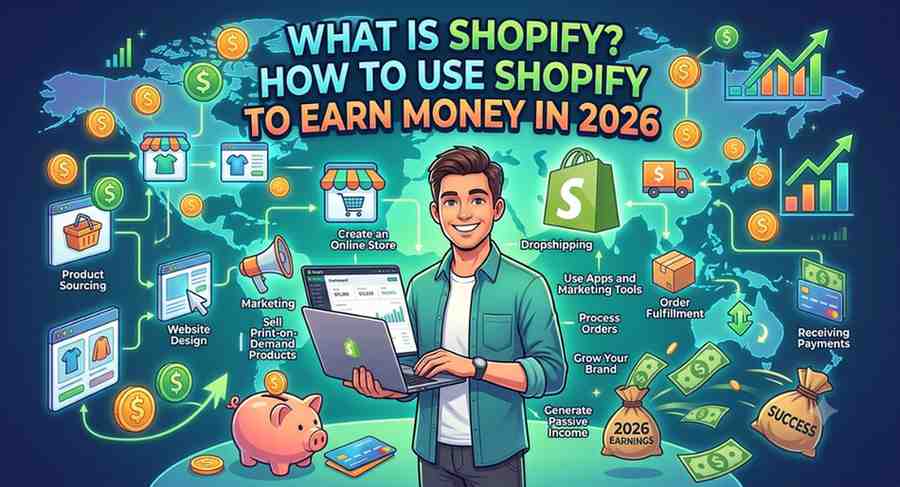
What is Shopify?
How to Use Shopify to Earn Money
From setting up your first store to scaling with dropshipping, digital products, and affiliate income — your complete, no-fluff guide to making money on Shopify.
What is Shopify?
Shopify is a fully hosted commerce platform that lets individuals, small businesses, and global brands build and manage online stores — without needing to code. Founded in 2006 in Ottawa, Canada, Shopify has grown into one of the most powerful eCommerce ecosystems in the world, powering everyone from solo side-hustlers to household names like Gymshark, Allbirds, Kylie Cosmetics, Mattel, and Converse.
At its core, Shopify gives you a single, unified system to:
- Build and customise a professional storefront
- List and manage products or services
- Accept payments in multiple currencies
- Handle shipping, fulfilment, and inventory
- Run marketing campaigns across Google, Meta, TikTok, and Pinterest
- Sell both online and in physical stores via Shopify POS
“Every day, millions of people use Shopify to power their businesses — from online side hustles to global retail giants.”
Shopify isn’t just for product sellers either. The platform supports service providers, content creators, coaches, and digital product vendors. Its App Store hosts thousands of third-party integrations — from email marketing and customer loyalty tools to AI-driven personalisation — making it infinitely extensible.
In Q1 2026, Shopify’s GMV hit $101 billion — a 35% year-over-year increase — with total revenue of $3.2 billion, beating analyst expectations. Full-year 2025 GMV reached $378 billion, up 29% on the prior year. Shopify has now facilitated over $1.7 trillion in cumulative GMV since inception.
How does Shopify work?
Shopify is a software-as-a-service (SaaS) platform — meaning everything (hosting, security, software updates, and infrastructure) is managed for you in exchange for a monthly subscription fee. You log in to the Shopify Admin dashboard and manage your entire business from one place.
Core components of a Shopify store
| Component | What it does |
|---|---|
| Online Store | Your public-facing website, built with drag-and-drop or AI-powered tools |
| Product Pages | Listings for physical items, digital files, or services |
| Shopify Checkout | Industry-leading checkout with Shop Pay, the highest-converting accelerated checkout available |
| Shopify Payments | Built-in payment processor — no third-party gateway needed |
| Admin Dashboard | Orders, inventory, analytics, customer data, and marketing in one panel |
| App Store | 8,000+ apps for reviews, email, subscriptions, loyalty, and more |
| Shopify Magic (AI) | AI tools for product descriptions, image editing, and discount automation |
Once a customer places an order, Shopify handles payment capture, notifies you and the buyer, and — if you’re dropshipping — can route orders automatically to your supplier. Built-in analytics track everything from traffic sources and conversion rates to customer lifetime value, so you can make data-driven decisions as you grow.
In 2025, Shopify introduced Shopify Magic — an AI system embedded across the platform that can auto-generate product descriptions, create discount codes, assist with image editing, and even suggest store improvements, dramatically lowering the learning curve for new merchants.
Shopify pricing plans (2025)
Shopify offers a 3-day free trial (no credit card required), followed by a promotional rate of $1/month for your first 3 months on most plans. After that, standard monthly pricing applies. Opting for annual billing saves 20–25% versus month-to-month.
A practical guide: move from Basic → Grow around $40K/month in revenue (fee savings cover the difference); upgrade to Advanced around $150K/month when deeper reporting and international markets matter. Consider Shopify Plus (from $2,300/month) if you’re approaching $2M+ annually or need B2B and enterprise automation.
Note that transaction fees apply if you don’t use Shopify Payments (2% on Basic, 1% on Grow, 0.6% on Advanced). Using Shopify Payments eliminates these. Credit card processing rates range from 2.9% + 30¢ (Basic) to 2.5% + 30¢ (Advanced) for online transactions.
How to set up your Shopify store
Getting a Shopify store live is faster than most people expect. Here’s the standard setup journey:
- Start your free trial. Visit shopify.com, enter your email, and begin the 3-day trial — no credit card required.
- Choose your niche and products. Before anything else, decide what you’re selling. The best Shopify businesses fit a well-defined niche with a built-in target audience. Niche clarity drives better SEO, ads, and conversions.
- Pick a theme. Shopify offers free and premium themes. Premium themes typically cost $180–$350 as a one-time purchase and are worth the investment once you start generating traction.
- Add your products. Upload product photos, write SEO-optimised titles and descriptions (Shopify Magic can help), and set pricing and inventory. For services, simply uncheck “this is a physical product.”
- Configure payments and shipping. Enable Shopify Payments to avoid transaction fees. Set up shipping zones, rates, and — if dropshipping — connect your supplier integration (DSers, Spocket, etc.).
- Set up a custom domain. A custom domain (e.g. yourbrand.com) costs around $14/year and is essential for brand credibility. Shopify includes free SSL/TLS with all plans.
- Launch and promote. Publish your store, connect Google and Meta channels for product catalogue syncing, and start driving traffic via SEO, social media, and paid ads.
10+ proven ways to earn money with Shopify
The beauty of Shopify is that it’s not just a place to sell physical goods. There are multiple revenue models — and several require zero upfront inventory investment. Here are the most proven paths:
Jewellery brand Ring to Perfection scaled from small monthly sales to six-figure monthly revenue within its first year using Shopify dropshipping — powered by social proof reviews, aggressive Facebook ad testing, and Shopify’s native upsell features.
Marketing your Shopify store
Traffic is the lifeblood of any Shopify store. Here are the most effective channels, ranked by cost efficiency:
Search Engine Optimisation (SEO)
Shopify has built-in SEO tools for product pages, meta descriptions, and URL structures. Creating a blog within your Shopify store is one of the highest-ROI strategies available — blog posts rank on Google, establish authority in your niche, and drive organic traffic for years after publication. Target long-tail keywords with clear buyer intent.
Social Media Marketing
Shopify integrates natively with Instagram, Facebook, TikTok, and Pinterest, allowing you to sync your product catalogue and run shoppable posts. TikTok ads deliver strong ROAS for younger demographics; Meta ads remain effective for broad audiences. Organic content on Instagram and Pinterest is especially powerful for visual niches like fashion, beauty, and home décor.
Email Marketing
Email consistently delivers the highest return on investment of any digital marketing channel. Use Shopify Email (native) or tools like Klaviyo to build automated sequences for cart abandonment recovery, post-purchase upsells, and new-subscriber welcome flows. Exit-intent popups typically convert 4% of abandoning visitors.
Paid Advertising
Once you’ve validated a product organically, scale with paid ads. Google Shopping campaigns target buyers with high purchase intent, while Meta and TikTok ads work well for discovery-phase products. Shopify Audiences — available on higher-tier plans — uses commerce data to build custom ad audiences that reduce cost-per-acquisition.
Influencer Partnerships
Micro-influencers (10K–100K followers) in your niche often deliver better conversion rates than mass influencers at a fraction of the cost. Shopify’s affiliate tracking tools let you manage and measure influencer-driven sales precisely.
Shop Pay — Shopify’s accelerated checkout — processed $67 billion in Q1 2026, representing 67% of total GMV, up from 60% in Q1 2024. Shopify is now the only platform enabling product discovery and selling directly inside ChatGPT, Microsoft Copilot, and Google — opening entirely new sales channels for merchants.