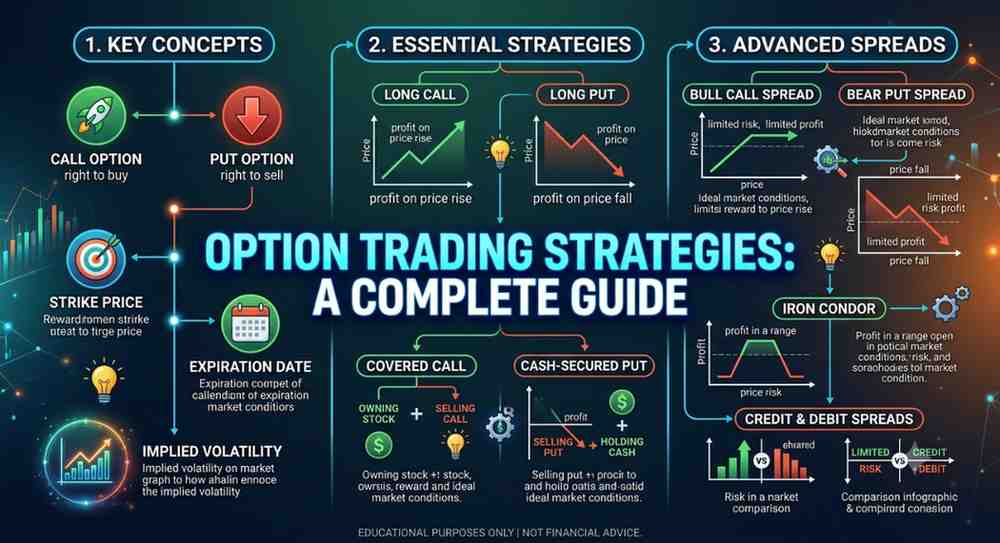
Option Trading Strategies: A Complete Guide With Payoff Charts
Option trading can be a powerful tool for investors looking to enhance returns, hedge risks, or speculate on market movements. Understanding the various strategies and their associated payoff profiles is crucial for successful implementation. This comprehensive guide delves into popular option trading strategies, explaining their mechanics, potential risks, rewards, and illustrating them with clear payoff charts.
What Are Options?
An option is a contract that gives the buyer the right, but not the obligation, to buy or sell an underlying asset at a predetermined price (the strike price) on or before a specific date (the expiration date). For this right, the buyer pays a premium to the seller.
- Call Option: Gives the holder the right to buy the underlying asset.
- Put Option: Gives the holder the right to sell the underlying asset.
Understanding Payoff Charts
Payoff charts are graphical representations that illustrate the profit or loss of an option strategy at various underlying asset prices at expiration. They are indispensable for visualizing the risk-reward profile of each strategy.
Basic Option Strategies
1. Long Call
A long call strategy involves buying a call option. This strategy is employed when an investor expects the price of the underlying asset to rise significantly. The potential profit is theoretically unlimited, while the maximum loss is limited to the premium paid.
Mechanics: Buy a call option with a specific strike price and expiration date.
Market View: Bullish.
Maximum Profit: Unlimited (Stock Price – Strike Price – Premium).
Maximum Loss: Premium Paid.
Break-even Point: Strike Price + Premium.
2. Short Call
A short call strategy involves selling (writing) a call option. This is typically done when an investor expects the underlying asset’s price to remain stable or fall. It generates income from the premium received, but carries theoretically unlimited risk if the stock price rises sharply.
Mechanics: Sell a call option with a specific strike price and expiration date.
Market View: Bearish to Neutral.
Maximum Profit: Premium Received.
Maximum Loss: Unlimited (Premium Received – (Stock Price – Strike Price)).
Break-even Point: Strike Price + Premium.
3. Long Put
A long put strategy involves buying a put option. Investors use this strategy when they anticipate a significant decline in the underlying asset’s price. It can also be used to hedge against potential losses in a stock portfolio. The maximum profit is substantial, while the maximum loss is limited to the premium paid.
Mechanics: Buy a put option with a specific strike price and expiration date.
Market View: Bearish.
Maximum Profit: Substantial (Strike Price – Stock Price – Premium).
Maximum Loss: Premium Paid.
Break-even Point: Strike Price – Premium.
4. Short Put
A short put strategy involves selling (writing) a put option. This strategy is used when an investor expects the underlying asset’s price to remain stable or rise. It generates income from the premium received, but carries significant risk if the stock price falls sharply.
Mechanics: Sell a put option with a specific strike price and expiration date.
Market View: Bullish to Neutral.
Maximum Profit: Premium Received.
Maximum Loss: Substantial (Premium Received – (Strike Price – Stock Price)).
Break-even Point: Strike Price – Premium.
Combination Option Strategies
5. Covered Call
A covered call strategy involves selling call options against shares of stock already owned. This is a popular strategy for income generation, as the investor collects the premium from selling the call. The risk is that the stock price rises above the strike price, and the shares are called away.
Mechanics: Own 100 shares of stock and sell 1 call option against them.
Market View: Neutral to Moderately Bullish.
Maximum Profit: Limited (Strike Price – Purchase Price of Stock + Premium Received).
Maximum Loss: Substantial (Purchase Price of Stock – Premium Received).
Break-even Point: Purchase Price of Stock – Premium Received.
6. Protective Put
A protective put strategy involves buying a put option on shares of stock already owned. This acts as an insurance policy, limiting potential losses if the stock price falls. It’s a bearish to neutral strategy, where the cost of the insurance (premium) reduces potential upside.
Mechanics: Own 100 shares of stock and buy 1 put option.
Market View: Bearish to Neutral (Hedge).
Maximum Profit: Unlimited (Stock Price – Purchase Price of Stock – Premium Paid).
Maximum Loss: Limited (Purchase Price of Stock + Premium Paid – Strike Price).
Break-even Point: Purchase Price of Stock + Premium Paid.
7. Long Straddle
A long straddle involves buying both a call and a put option with the same strike price and expiration date. This strategy profits from significant price movement in either direction, but requires a large move to cover the cost of both premiums.
Mechanics: Buy one call and one put option with the same strike price and expiration date.
Market View: Volatile (Direction Neutral).
Maximum Profit: Unlimited.
Maximum Loss: Total Premiums Paid.
Break-even Points: Strike Price + Total Premiums Paid, and Strike Price – Total Premiums Paid.
8. Long Strangle
A long strangle is similar to a long straddle but uses out-of-the-money options. It involves buying an out-of-the-money call and an out-of-the-money put with the same expiration date. This strategy is cheaper than a straddle but requires an even larger price movement to be profitable.
Mechanics: Buy an OTM call and an OTM put with the same expiration date.
Market View: Highly Volatile (Direction Neutral).
Maximum Profit: Unlimited.
Maximum Loss: Total Premiums Paid.
Break-even Points: Call Strike + Total Premiums Paid, and Put Strike – Total Premiums Paid.
Advanced Option Strategies
9. Bull Call Spread
A bull call spread involves buying a call option at a lower strike price and selling a call option at a higher strike price, both with the same expiration date. This strategy is used when an investor is moderately bullish and wants to reduce the cost of buying a call option, but it also limits potential profits.
Mechanics: Buy 1 OTM Call, Sell 1 further OTM Call (same expiration).
Market View: Moderately Bullish.
Maximum Profit: Limited (Higher Strike – Lower Strike – Net Premium Paid).
Maximum Loss: Net Premium Paid.
Break-even Point: Lower Strike + Net Premium Paid.
10. Bear Put Spread
A bear put spread involves buying a put option at a higher strike price and selling a put option at a lower strike price, both with the same expiration date. This strategy is used when an investor is moderately bearish and wants to reduce the cost of buying a put option, but it also limits potential profits.
Mechanics: Buy 1 OTM Put, Sell 1 further OTM Put (same expiration).
Market View: Moderately Bearish.
Maximum Profit: Limited (Higher Strike – Lower Strike – Net Premium Paid).
Maximum Loss: Net Premium Paid.
Break-even Point: Higher Strike – Net Premium Paid.
11. Iron Condor
An iron condor is a non-directional strategy that profits from low volatility. It involves selling an out-of-the-money call spread and an out-of-the-money put spread. The maximum profit is limited to the net premium received, and the maximum loss is also limited.
Mechanics: Sell 1 OTM Call, Buy 1 further OTM Call, Sell 1 OTM Put, Buy 1 further OTM Put (all same expiration).
Market View: Neutral/Low Volatility.
Maximum Profit: Net Premium Received.
Maximum Loss: Difference between strike prices of either spread – Net Premium Received.
Break-even Points: Upper Call Strike – Net Premium, Lower Put Strike + Net Premium.
12. Butterfly Spread
A butterfly spread is a neutral strategy that profits from low volatility. It involves combining three strike prices: buying one call at a low strike, selling two calls at a middle strike, and buying one call at a high strike (all with the same expiration). It can also be constructed with puts.
Mechanics: Buy 1 Call (low strike), Sell 2 Calls (middle strike), Buy 1 Call (high strike) – all same expiration.
Market View: Neutral/Low Volatility.
Maximum Profit: Limited (Middle Strike – Lower Strike – Net Premium Paid).
Maximum Loss: Net Premium Paid.
Break-even Points: Lower Strike + Net Premium Paid, and Higher Strike – Net Premium Paid.
Conclusion
Option trading strategies offer a versatile approach to navigating financial markets, allowing investors to tailor their risk and reward profiles to specific market outlooks. From basic calls and puts to complex spreads like the Iron Condor, each strategy has unique characteristics. A thorough understanding of these strategies, coupled with careful risk management, is essential for any option trader.