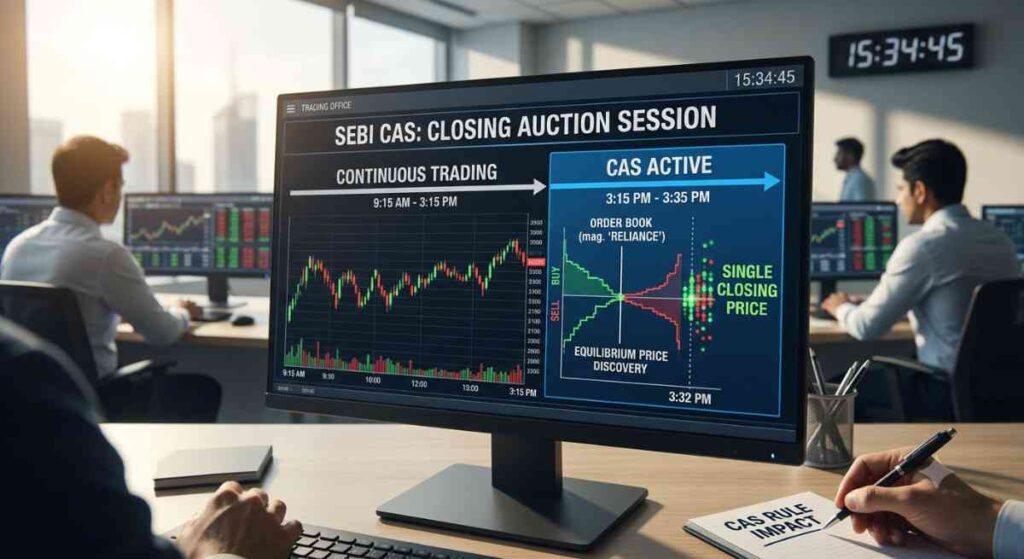
What is SEBI’s New Closing Auction Session (CAS)?
The Securities and Exchange Board of India (SEBI) has introduced a major structural shift in how official closing prices are calculated for stocks listed in the Futures & Options (F&O) segment.
Under the new framework, the traditional Volume-Weighted Average Price (VWAP)—which calculated closing prices based on the final 30 minutes of regular trading—is replaced by a dedicated 15-to-20 minute Closing Auction Session (CAS). During CAS, buy and sell orders are pooled together and matched at a single equilibrium price, aligning India’s stock exchanges with global market standards like the NYSE and LSE.
Why Has SEBI Introduced the Closing Auction Session?
SEBI implemented CAS to solve structural price discovery inefficiencies during market closes. Key reasons for this reform include:
Accurate Price Discovery: Aggregating market liquidity into a single auction prevents last-minute order manipulation and sudden price spikes.
Lower Tracking Error for Passive Funds: Index funds and Exchange-Traded Funds (ETFs) benefit from a single, representative benchmark price at market close.
Global Best Practices: Major international stock exchanges rely on closing auctions to calculate EOD (End of Day) stock valuations smoothly.
How CAS Changes the Trading Day Schedule
The implementation of CAS alters daily continuous trading schedules for F&O stocks while non-F&O stocks continue under the existing system.
| Trading Stage | CAS-Enabled (F&O) Stocks | Non-F&O Stocks |
| Continuous Trading (CTS) | 9:15 AM – 3:15 PM | 9:15 AM – 3:30 PM |
| Intraday Auto Square-Off | ~3:05 PM | ~3:20 PM |
| Transition & Reference Price | 3:15 PM – 3:20 PM | N/A (Trading continues) |
| Closing Auction Session (CAS) | 3:20 PM – 3:35 PM | N/A |
| F&O Derivatives Segment | Extended to 3:40 PM | N/A |
| Post-Close Session | 3:50 PM – 4:00 PM | 3:40 PM – 4:00 PM |
Breakdown of the CAS Mechanism (3:15 PM to 3:35 PM)
The Closing Auction Session follows a 4-stage process:
3:15 PM – 3:20 PM (Transition): Continuous trading stops for F&O stocks. A reference price is established, and pending eligible orders carry over.
3:20 PM – 3:25 PM (Order Entry Period I): Traders can place, modify, or cancel Limit and Market Protection orders.
3:25 PM – 3:30 PM (Order Entry Period II): Only Limit orders are permitted. Order entry ends randomly in the final 2 minutes to prevent system gaming.
3:30 PM – 3:35 PM (Order Matching): The exchange matches buy and sell orders at a single equilibrium price, which becomes the official closing price.
Allowed and Restricted Orders During CAS
Not all order types behave the same way during the Closing Auction Session.
Allowed: Standard Limit Orders and Market Protection Orders (MPP).
Automatically Cancelled at 3:15 PM: Stop-Loss (SL) orders, Iceberg orders, and Good-Till-Triggered (GTT) orders for CAS-eligible stocks.
Rejected: Immediate-or-Cancel (IOC) orders placed during the auction.