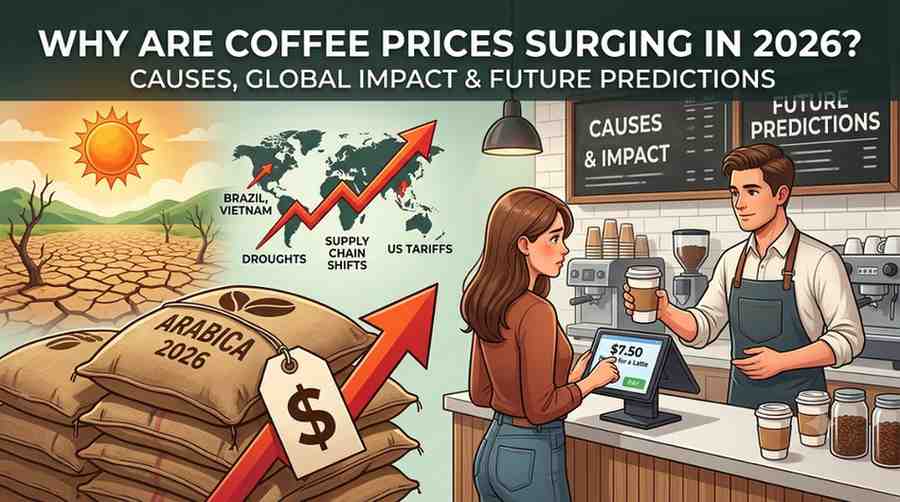
Why Are Coffee Prices Surging in 2026? Causes, Global Impact & Future Predictions
Coffee has quietly become one of the most disruptive stories in global food inflation. Retail prices in early 2026 hit record highs, arabica futures spiked to levels not seen since the 1970s, and coffee shops from independent roasters to Starbucks have been forced to rethink how they do business. Here’s what’s actually driving the surge — and what may happen next.
A Crisis Decades in the Making
Coffee traders and economists keep reaching for the same comparison: 1977, the last time a Brazilian frost sent prices spiraling for years. Industry analysts now describe the current run-up as the steepest and most sustained increase since U.S. price tracking began in 1980. Unlike a short-lived weather scare, this surge has been building for roughly two years and shows no clean end in sight.
The Core Causes Behind the Surge
1. Back-to-back crop failures in Brazil and Vietnam
Brazil and Vietnam together supply the majority of the world’s coffee — Brazil dominates arabica production, while Vietnam is the leading robusta grower. Both countries suffered historically poor harvests, with drought and erratic rainfall damaging Brazilian arabica trees and typhoons flattening robusta plantations in Vietnam. When the two largest suppliers falter in the same season, there is no easy substitute source to fall back on.
2. Panic buying on thin inventories
Global coffee stockpiles were already running low before the bad harvests hit. As the scale of the shortfall became clear, roasters worldwide rushed to lock in supply at the same time, and that scramble itself pushed prices higher — a self-reinforcing spiral on top of the underlying shortage.
3. Tariffs and trade friction
New U.S. tariffs added a direct cost layer on top of already-elevated bean prices, including a steep additional levy on Brazilian coffee imports tied to a political dispute, and a separate high tariff rate affecting Vietnam. Even when tariff rates have been adjusted or paused, the uncertainty alone has encouraged hedge funds and importers to bid futures prices upward in anticipation of further increases.
4. Shipping and logistics disruption
Security threats in the Red Sea forced vessels carrying African coffee to reroute around the Horn of Africa, lengthening transit times and raising freight costs. Renewed instability around the Strait of Hormuz has added further pressure on shipping, insurance, and fuel costs that ripple through the entire import chain.
5. Regulatory transition costs
The European Union’s deforestation regulation, aimed at guaranteeing imported coffee isn’t linked to deforestation, is a reasonable long-term goal — but the compliance and traceability requirements are adding near-term cost and complexity for exporters and importers navigating the transition.
The Global Impact
Consumers are paying more everywhere
From grocery store shelves to café counters, the increase has been broad-based. Ground roast coffee, single-origin beans, cold brew, and espresso-based drinks have all seen meaningful price increases, with prepared specialty drinks at large chains showing some of the sharpest percentage jumps.
Coffee shops are being squeezed from both sides
Independent cafés face a difficult balancing act: absorb rising bean costs and watch margins shrink, or pass costs on and risk losing price-sensitive customers. Many are responding by roasting in-house to cut out wholesale markups, diversifying bean origins away from Brazil toward Ethiopia, Colombia, and East Africa, or adding transparent surcharges instead of quietly raising menu prices.
Even the largest chains are not immune
Starbucks, one of the largest coffee retailers in the world, has undertaken a broad restructuring that includes closing underperforming locations, corporate layoffs, and absorbing significant added cost rather than passing all of it to customers — a sign that scale alone doesn’t insulate a business from a commodity shock of this size.
| Factor | Primary Region Affected | Type of Pressure |
|---|---|---|
| Drought & erratic rainfall | Brazil | Supply shortage |
| Typhoon damage | Vietnam | Supply shortage |
| Import tariffs | United States | Direct cost increase |
| Red Sea & Strait of Hormuz disruption | Global shipping routes | Freight & insurance cost |
| EUDR compliance transition | European Union imports | Regulatory & traceability cost |
What Comes Next: Future Predictions for 2026 and Beyond
Some relief may be on the way — slowly
There are genuine reasons for cautious optimism. Brazil’s 2026 harvest is expected to be stronger, and Colombia has reported one of its most productive harvests in decades. If favorable weather holds, farm-level bean prices could ease in the second half of the year.
But retail prices are likely to stay sticky
Because roasters buy months ahead through futures contracts, cheaper beans at the farm level won’t translate into cheaper store prices overnight. Many analysts expect retail prices to remain near record levels well after wholesale costs start to soften.
Volatility may be the new normal
Some industry voices believe elevated, unpredictable pricing isn’t a temporary phase but a structural shift, driven by the combined effect of climate volatility, geopolitical risk, and thinner global inventories. Even a single weather event in Brazil’s upcoming flowering season — a critical window watched closely by traders — could quickly reverse any near-term easing.
Structural shifts to watch
- Origin diversification: more buyers sourcing from Ethiopia, Uganda, and other East African producers to reduce dependence on Brazil and Vietnam.
- In-house roasting growth: more cafés bypassing wholesale roasters to control costs directly.
- Climate adaptation investment: longer-term efforts in drought-resistant coffee varieties and improved farming practices in producing regions.
- Continued trade policy uncertainty: tariff decisions remaining a wildcard that can move futures prices independent of actual supply.
The Bottom Line
The 2026 coffee price surge isn’t the result of one single cause — it’s the product of climate shocks in the two biggest producing countries, thin global inventories, tariff-driven cost increases, shipping disruptions, and a regulatory transition all arriving at roughly the same time. Some easing is possible if upcoming harvests perform well, but given how many of these pressures are structural rather than temporary, coffee drinkers and business owners alike should expect prices to stay historically high — and unpredictable — for the foreseeable future.