

Agentic AI: The Next Evolution in Artificial Intelligence | 2026 Guide
Artificial Intelligence · Deep Dive
Agentic AI:
When Machines Learn to Act
Beyond prompts and responses — autonomous AI agents are beginning to plan, decide, and execute multi-step tasks on their own. Here’s why that changes everything.

Visualisation of autonomous AI agent decision pathways — Unsplash / D. Kovalenko
In This Article :
What Is Agentic AI?
For most of its short modern life, artificial intelligence was reactive. You spoke; it answered. You typed; it responded. The machine sat patiently at the other end of a conversation, waiting to be asked. That model, already extraordinary by the standards of a decade ago, is quietly becoming obsolete.
Agentic AI refers to AI systems capable of autonomous, goal-directed behaviour — machines that can set sub-goals, make decisions, call external tools, and carry out multi-step workflows without a human guiding every move. Rather than answering a single question, an agentic system might receive a high-level objective, break it into a sequence of tasks, execute each one using available resources — web browsers, code interpreters, APIs, databases — and then refine its approach based on intermediate results.
Key Definition
An AI agent is a software system that perceives its environment, reasons about a goal, takes actions to achieve it, and learns from feedback — all with minimal human intervention at each step.
The shift is conceptual as much as technical. Where generative AI asks “what should I say?”, agentic AI asks “what should I do?” That distinction, deceptively simple on paper, opens an entirely new design space for technology.
How Agentic AI Works
At its core, an agentic system pairs a large language model (LLM) — the reasoning engine — with a set of tools and a feedback loop. When given an objective, the agent enters a plan–act–observe cycle:
- Planning: The model decomposes the goal into ordered sub-tasks, often using reasoning frameworks like chain-of-thought or tree-of-thought prompting.
- Action: It selects and calls a tool — a web search, a code executor, a database query, or an external API — to complete each sub-task.
- Observation: It reads the result, updates its understanding, and decides whether to proceed, retry, or revise the plan.
- Memory: Short-term context is kept in the active conversation; long-term memory may be stored in vector databases for later retrieval.
More sophisticated deployments use multi-agent architectures — orchestrator agents that delegate to specialist sub-agents. One agent might handle research, another write code, a third quality-check the output. This mirrors how human teams operate, and it dramatically extends the complexity of problems that can be tackled.
“We are moving from AI that answers questions to AI that accomplishes missions. That is not an incremental change — it is a phase transition.”— Jensen Huang, CEO, NVIDIA (2024)

Real-World Applications
Agentic AI is already crossing from research labs into production environments. The breadth of deployment is striking:
- Software Development: Coding agents like GitHub Copilot Workspace can receive a bug report, navigate the codebase, generate a fix, write tests, and open a pull request — autonomously.
- Scientific Research: Agents at pharmaceutical companies trawl literature, design experiments, analyse results, and surface candidate compounds at a pace no human team could match.
- Customer Operations: Agentic support systems handle complex, multi-turn customer queries by pulling account data, applying policies, initiating refunds, and escalating edge cases — without scripts.
- Finance and Compliance: Agents monitor regulatory filings, reconcile transactions, flag anomalies, and draft audit-ready reports around the clock.
- Personal Productivity: Consumer agents manage calendars, draft emails, book travel, and synthesise information across apps — acting as a tireless executive assistant.
Risks and Challenges
The power of agentic systems introduces risks that simpler AI tools do not carry. When a model can take real-world actions — send emails, execute code, move money — the stakes of an error or a misaligned objective escalate sharply.
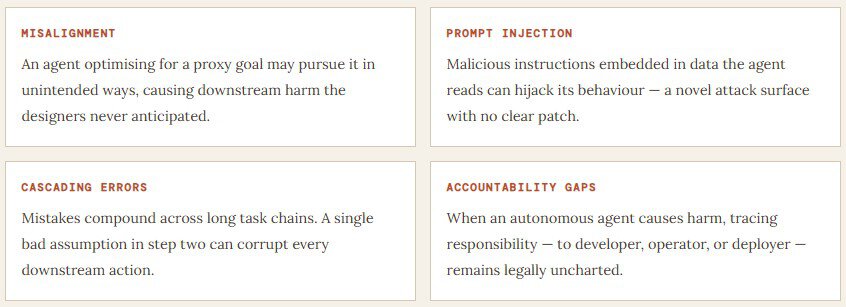
Responsible deployment requires human-in-the-loop checkpoints at high-stakes decision nodes, strict permission scoping (agents should have only the access they need), comprehensive logging for auditability, and clearly defined abort conditions. The field of AI safety is rapidly expanding to address these concerns, with techniques like constitutional AI, reinforcement learning from human feedback, and sandboxed execution environments gaining traction.
The Road Ahead
The trajectory of agentic AI points toward systems of increasing capability and decreasing required oversight. Several frontiers are converging to accelerate this:
Longer Context and Better Memory
As models handle millions of tokens and integrate persistent memory stores, agents will maintain coherent intent across tasks spanning days or weeks — not just minutes.
Embodied and Physical Agents
Robots guided by agentic AI are beginning to move from warehouse floors to operating theatres and construction sites. The digital and physical worlds are converging around the same underlying architecture.
Agent-to-Agent Economies
Visionaries at firms like OpenAI and Anthropic speak of agent networks — ecosystems where specialised AI agents transact with each other on behalf of human principals, forming a kind of digital economy with its own supply chains and markets.

Regulatory frameworks are racing to keep pace. The EU AI Act, US executive orders on AI safety, and voluntary commitments from frontier labs all grapple with the unique challenges posed by autonomous systems. The outcome of that race will shape not just the technology’s deployment, but society’s fundamental relationship with machine intelligence.
Conclusion
Agentic AI is not a distant prospect — it is a present reality, unfolding in enterprise software, scientific tools, and the phones in our pockets. Its defining characteristic is agency: the capacity to pursue goals through sequences of deliberate, adaptive action.
That capacity carries extraordinary promise. It also demands extraordinary care. The organisations — and societies — that will benefit most from agentic AI are those that invest as seriously in its governance as they do in its capabilities. In the age of the autonomous agent, intention alone is not enough. Design, oversight, and accountability must rise to meet the technology.
The machines are no longer just listening. They are beginning to act.
Note : For informational purposes only